
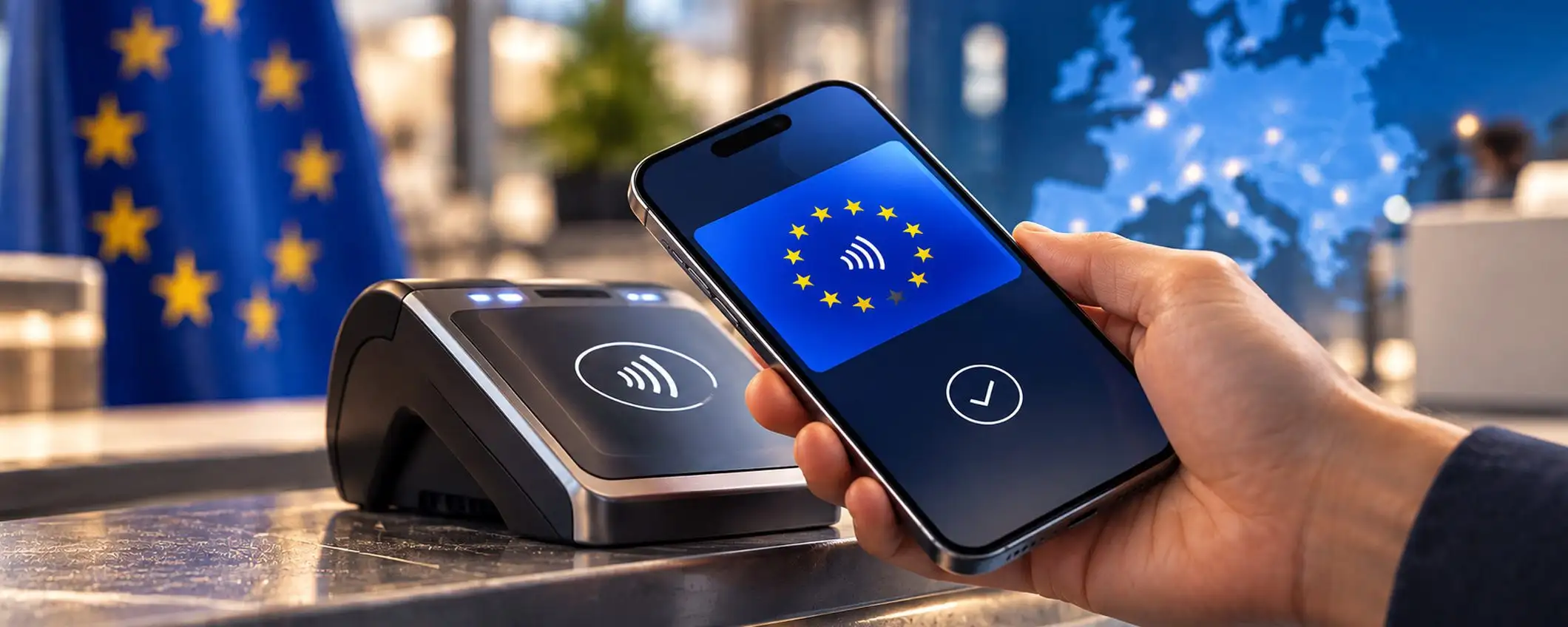
The new European payment circuit: to an alternative to large international networks
Europe is preparing to strengthen its autonomy in the field of digital payments. The idea of a new European payment circuit arises from the need to reduce the dependence of the continental market from large international networks and to build an infrastructure capable of managing payments within the Union in a more integrated, competitive and resilient way.
The theme has become increasingly strategic with the growth of electronic payments and the progressive reduction of the use of cash. Cards, smartphones and online payments are now part of the daily lives of millions of European citizens, but a significant share of transactions still passes through infrastructure controlled by non-European operators.
the new European circuit and the future of e-commerce
The new European payment circuit could also play a strategic role in the development of e-commerce, a sector where international competition is now closely linked to the availability of efficient, safe and easily accessible payment infrastructure.
For online purchases, payment is one of the most delicate steps of the entire sales process. An integrated European system could offer consumers a recognizable and usable payment method in different EU countries, reducing differences between national markets.
A more integrated digital market
One of the main advantages could cover cross-border purchases. Today an Italian consumer who buys from a French, German or Spanish online store can meet different payment methods, intermediaries and conditions.
A common European circuit could help make the experience more uniform. For an e-commerce it would be possible to offer a potentially recognizable payment method throughout the Union, without having to build a completely different strategy for each market.
This could be particularly relevant for small and mediumsized enterprises, which are an important component of the European economy and which often encounter greater difficulties in expanding beyond national borders.
More choice for traders and consumers
The entry of a new circuit would also increase competition in the online payment market. E-commerce operators may have a greater choice between different payment systems and, in perspective, negotiate more favourable conditions.
For consumers, however, the advantage could result in the possibility of using a European payment method directly linked to their banking ecosystem, without necessarily relying on international circuits.
However, convenience will be decisive: a new system will be able to assert itself in e-commerce only if it is easy to use, widely accepted and competitive on the cost front.
Checkout simpler
Another fundamental element concerns checkout, i.e. the final moment of online purchase. Each additional step can increase the risk that the customer abandons the cart.
An integrated European payment system could focus on simplifying the purchasing experience: rapid identification, payment authorization, secure authentication and uniform transaction management in different countries.
The goal would be to transform payment from possible obstacle to conversion into an almost invisible element of the purchasing experience.
Instant payments and new business models
The connection with e-commerce becomes even more interesting if the European circuit will be integrated with instant payment infrastructure.
The possibility of transferring money immediately could allow merchants to receive confirmation of payment in very short time, improving the management of orders and cash flow.
New models could also be developed, such as account-to-account payments, integrated marketplace solutions and faster refund systems.
An opportunity for European e-commerce
The real stake, therefore, is not just creating an alternative to existing circuits. A European infrastructure could become an element of the strategy to build a more integrated digital market.
If the system succeeds in combining security, competitive costs, wide acceptance and ease of use, e-commerce could be one of the main beneficiary sectors.
For European companies, this would mean having a common payment infrastructure to sell more easily beyond national borders. For consumers, it may mean you can buy online throughout Europe with a more uniform experience.
Ultimately, the success of the new circuit could be measured not only by the number of issued cards or transactions made, but also by its ability to become a natural component of the European digital purchasing experience.